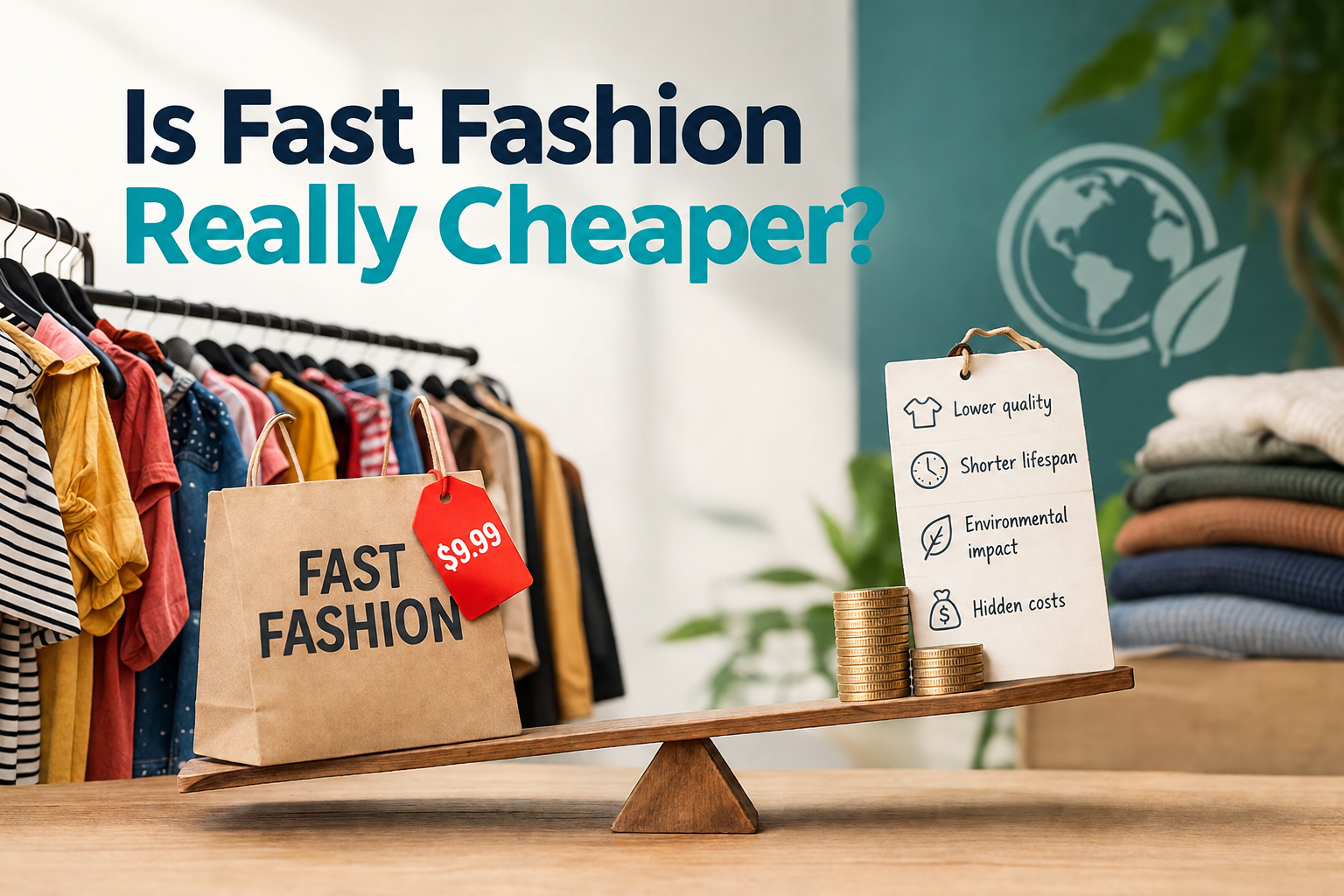
Is Fast Fashion Really Cheaper? The Slow Fashion Math No One Talks About

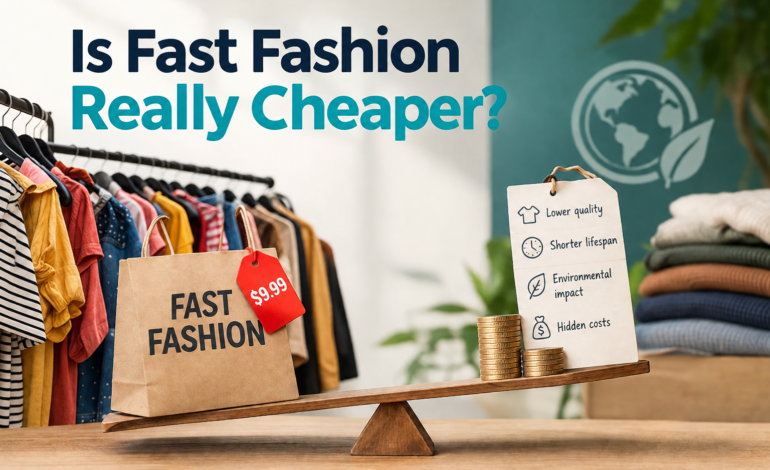
It is a real bargain for £6 a t-shirt. It’s a luxury of a £60 one from a small ethical label. As it seems on paper, fast fashion always prevails. Of course, this only applies if you don’t do the math once you get to “checkout,” but never again after that.
When you consider the lifetime of clothes, the poor quality of fast fashion items, how frequently they’re replaced, and what happens when they fall apart, the tale of slow fashion vs fast fashion clothes begins to take a turn around the fork. This is the math for which NOBODY walks you through before you purchase.
What “Cheap” Really Means: Price Tag vs Cost-Per-Wear
Fast fashion is sold at a lower price to make a quick sale, not a long-term value. The number that counts in your wallet is, however, cost per wear—what you paid, divided by how many times you wear it before it’s at the back of a drawer, or in a bin, or donated.
If this top is worn 4 times before the seams have broken, it will cost £1.50 per wear. A £60 piece that is worn 100 times over several years costs 60p per wear. Mathematically, the “cheap” option is the more costly option; it’s just that it’s distributed in an easy-to-miss manner, since writing a check every time you put it in is not the easy way.
That is the principle of the slow fashion argument: it’s not a matter of spending more; it’s a matter of spending sensibly.
Fast Fashion vs Slow Fashion: The Real Statistics
The figures are not just anecdotal. The research conducted by industry and environmental studies shows a similar picture:
- Today, the average piece of clothing is worn more than a third less often than it was 15 years ago.
- Textile waste has grown rapidly due to the mass production of cheap and throwaway fashion, with millions of tonnes of waste being disposed of in landfills or incinerated annually in the main fashion-consuming nations.
- Return and repurchase cycles have shortened; whereas a traditional retailer would release a handful of seasonal collections in a year, some fast fashion stores have been releasing thousands of new outfits.
When taken together, the fast fashion vs. slow fashion statistics make for a simple story: we’re buying more, keeping it for a shorter amount of time, and paying for that convenience in ways that aren’t evident on the receipt—the cost of landfill, the cost of resources, and the cost of a wardrobe that never feels “done.”
Ultra-Fast Fashion vs Fast Fashion: A Different Beast Entirely
It’s a good idea to separate these two, as they are not the same and are often confused.
Fast fashion (the many famous high street brands) is constantly changing its stock inventory in a few weeks, following the latest fashion trends, and moving them to shelves in a timely manner at affordable prices.
Ultra-fast fashion does that and escalates it to the nth degree. Some ultra fast fashion products can go from design to listing within days, putting thousands of products on the market each day at a price point that wasn’t taken into consideration when designing the garment: they are meant to be worn a few times and then thrown away.
The difference is significant when it comes to the math: ultra-fast fashion garments are likely to last even shorter than traditional fast fashion garments, which increases the difference in cost per wear between the two and well-made garments.
The Slow Fashion Math, Broken Down
If you aren’t going to purchase a stereo, here’s a quick way to do the math for yourself:
- Estimate the price. How much is the item worth at this time?
- Estimate realistic wear. Be honest: not how many times you plan to wear it, but how many times you’ve worn similar items you’ve purchased in the past.
- Calculate price/wear. This is what your true cost-per-wear is.
- Compare across options. A higher quality product that will last a much longer reasonable life is often cheaper per wear than the “bargain” version.
This does not mean that all items of high cost are necessarily the better investment, however: say a £200 item that is worn twice would be a poor deal. It’s not about the price; it’s about price and usage. That is the area of slow fashion vs fast fashion clothing decisions you will not be able to tell by the price of the item.
Slow Fashion vs Fast Fashion: Examples Side by Side
It is more easily visualized with a concrete comparison:
- A basic cotton t-shirt costs 50p per wear, worn about 10 times before it becomes misshapen, a result of the low cost of the clothing in the fast fashion industry. A good quality one which has been made to a high standard and worn 100+ times over a number of years, can cost less than 25p per wear.
- Cost: £40 of fast fashion vs £150 of slow fashion – £40 wears for one season, £150 wears for 5 seasons; the slow fashion coat wins, and the resale value doesn’t come into the equation.
- Denim jeans: Fashion jeans that are made quickly for £20 that fade and rip after a few months of wearing, whereas a pair that’s made to last several years that costs £70 is reinforced with stitching.
In each instance, the “expensive” deal is not actually the more costly option when you factor in the “time and durability” aspect—it’s just not as apparent at the till.
Slow Fashion Brands Worth Knowing
Slow fashion is not just about the high price tag; it’s about purchasing from brands that are made for the long haul, with high-quality fabric, and are open about where and how clothing is produced. Search for brands that share information about their supply chains, work with natural and recycled fibers, have repair options, or make smaller, more considered batches instead of constant “drop” cycles. The slow fashion path has become more affordable than ever before a couple of years ago—and more sustainable fashion brands have become available to people other than the wealthy.
Why Gen Z Is Rewriting the Rules on Sustainable Fashion
It’s a widely believed myth that younger consumers are the most loyal users of fast fashion, but on the surface, that seems to be true when looking at platform usage statistics. However, it’s more complex than that. Gen Z sustainable fashion practices are now more likely to be secondhand apps, clothing rentals, swap culture, and a true interest in cost-per-wear thinking, as much because of limited finances as it is because of the trend.
At the same time, this generation has had much greater exposure to the origins of their clothing and its destinations after use, making the “buy less, choose well” mantra more commonplace than ever, if not, for all intents and purposes, more than ever before.
Final Thoughts
At the till, yes. Over the lifetime of the garment, often not. The real answer depends on how long you keep and wear what you buy, not just what it costs to walk out of the shop with it.
The slow fashion argument isn’t a guilt trip about spending more—it’s a nudge to do the maths you’d naturally do for any other purchase. Judged by cost-per-wear rather than price tag alone, the “cheap” option frequently isn’t the deal it first appears to be.