
Struggling with Delays and Shortages? Here’s What Good Supply Chain Management Fixes

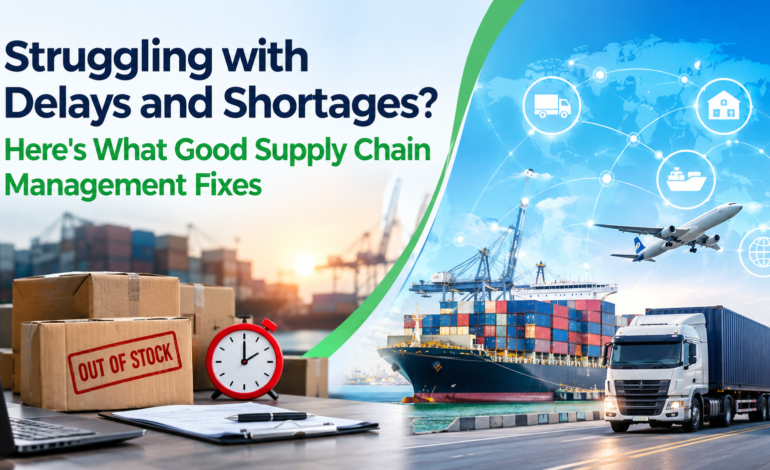
You are not the only one who has been getting complaints from customers for late deliveries, looking for other suppliers to get the products, or seeing the cost rising due to last-minute booking of freight. Unpredictability of demand, uncertainty about tariffs, and weak global supply chains have made disruption commonplace. Fortunately, most of these issues stem from problems in the supply chain, and they can be resolved.
What Supply Chain Management Actually Fixes
Supply Chain Management is the synchronisation of all the processes and activities involved in moving a product from raw material through to your customer’s doorstep as it pertains to sourcing, production, warehousing, transport and delivery. It’s a tool that essentially eliminates friction when executed effectively, thus eliminating delays and shortages that cause them in the first place.
Here’s what a properly managed supply chain solves:
1. Visibility gaps. Most delays are not caused by a major failure but rather by nobody noticing a minor failure until it is too late! Tracking from one supplier to another and from one logistics partner to another in real time allows for detecting a bottleneck before it turns into a stock-out.
2. Single point failures. Having a single supplier or shipping line is a risk. With good supply chain management, you ensure that you have backup suppliers and alternative routes, so that disruption doesn’t bring your whole operation to a standstill.
3. Poor demand forecasting. Often, shortages occur due to unsound judgment in ordering, which is made without data. More accurate predictions of demand and inventory result in less stock out and less overstocking.
4. Manual, disconnected processes. Buying, warehousing, and logistics departments operate their activities on different spreadsheets, and mistakes and delays compound. Centralizing data is the solution to that.
Should You Hire a Supply Chain Management Company or Build In-House?
A supply chain management company can be more of a quick solution for small and medium-sized businesses than hiring and training an in-house team to handle the supply chain. It is these companies that can introduce valuable networks of suppliers that already exist, as well as logistics connections and expertise that could take years to build from scratch.
That doesn’t apply to everyone, however. In larger enterprises that have complex, high-volume operations, the long term benefits of building in-house capability with the appropriate technology may be more beneficial—especially when supply chain performance is a competitive differentiator.
| Factor | Outsourced SCM Company | In-House Team |
| Setup speed | Fast—existing supplier and logistics networks are ready to use | Slower—requires hiring, training, and process-building |
| Upfront cost | Lower initial investment | Higher upfront investment in people and systems |
| Long-term cost | Ongoing service fees can add up at scale | Can be more cost-effective at high volume |
| Control | Less direct control over day-to-day decisions | Full control over strategy and execution |
| Expertise | Immediate access to specialized, proven expertise | Expertise builds gradually over time |
| Flexibility to scale | Easy to scale up or down with demand | Scaling requires more internal planning and hiring |
| Best fit for | Small and mid-sized businesses needing a fast, low-risk start | Larger enterprises where supply chain is a competitive advantage |
The Role of Supply Chain Management Software and Tools
While the best strategy is essential, it’s useless without the proper infrastructure to support it. That’s where supply chain management software and supply chain management tools come in: Software that gives you a single location for inventory, orders, suppliers, and shipments—without having to figure it out by yourself.
Look for software that will offer:
- Instant tracking of inventory and shipments. Real-time inventory and shipment tracking.
- Automated demand forecasting and reordering.
- Supplier performance monitoring
- Easy integration with existing ERP/accounting systems.
Enterprises don’t have to start with enterprise software. There are a lot of manual mistakes that can lead to delays, and a mid-tier platform can cost even small and growing businesses a high percentage of time.
What People Are Actually Saying (Including on Reddit)
Just do a quick search on the subject of supply chain management on Reddit, and you will find plenty of business owners and logistics pros sharing their experiences—the software they are using, horror stories about suppliers, or whether something is actually working for them or just a good sales pitch. If you’re looking to read practitioner-level reports without the polish, then this is a good place to start. Treat it as a starting point for research, but not as a replacement for advice for your particular business.
Is a Supply Chain Management Degree Worth It?
A degree in supply chain management provides a solid foundation to be used for any number of valid activities: procurement, logistics, demand planning, and operations strategy, to name a few. Since 2020, supply chains have played a major part in business resilience, and demand for individuals who know and understand the end-to-end of a supply chain continues to rise. It’s also a helpful indicator to be aware of when hiring a supply chain manager or consultant for a business.
Final Thoughts
Delays and shortages are not out of the blue—they are typically a sign of a supply chain that doesn’t have the visibility, backup, or tools to identify issues early enough. Whether it’s forcing a specialist company in, changing software, or hiring the right people, the businesses that win are those that regard supply chain management as a key business priority, not an afterthought.
About The Author