Dark Social: The Silent Force Reshaping How Brands Get Discovered

Introduction
All marketers have looked at an analytics dashboard and seen this: a significant portion of referrals categorized as “direct” with nothing to explain where they are coming from or a referral link attached. That elusive traffic falls into the dark social category and is one of the most powerful, least understood brand discovery forces today.
Commonly, the ones that matter when it comes to talking about products and content are those that happen away from the public sphere, in DMs, private group chats, text messages, or emails. Now it’s more than an option; it’s become a requirement to understand this shift and incorporate it into your marketing strategy.
What Is Dark Social? (Dark Social Meaning)
In 2012, writer Alexis Madrigal used the term “dark social” to refer to the huge number of shares made via direct, untrackable channels that are not public social posts.
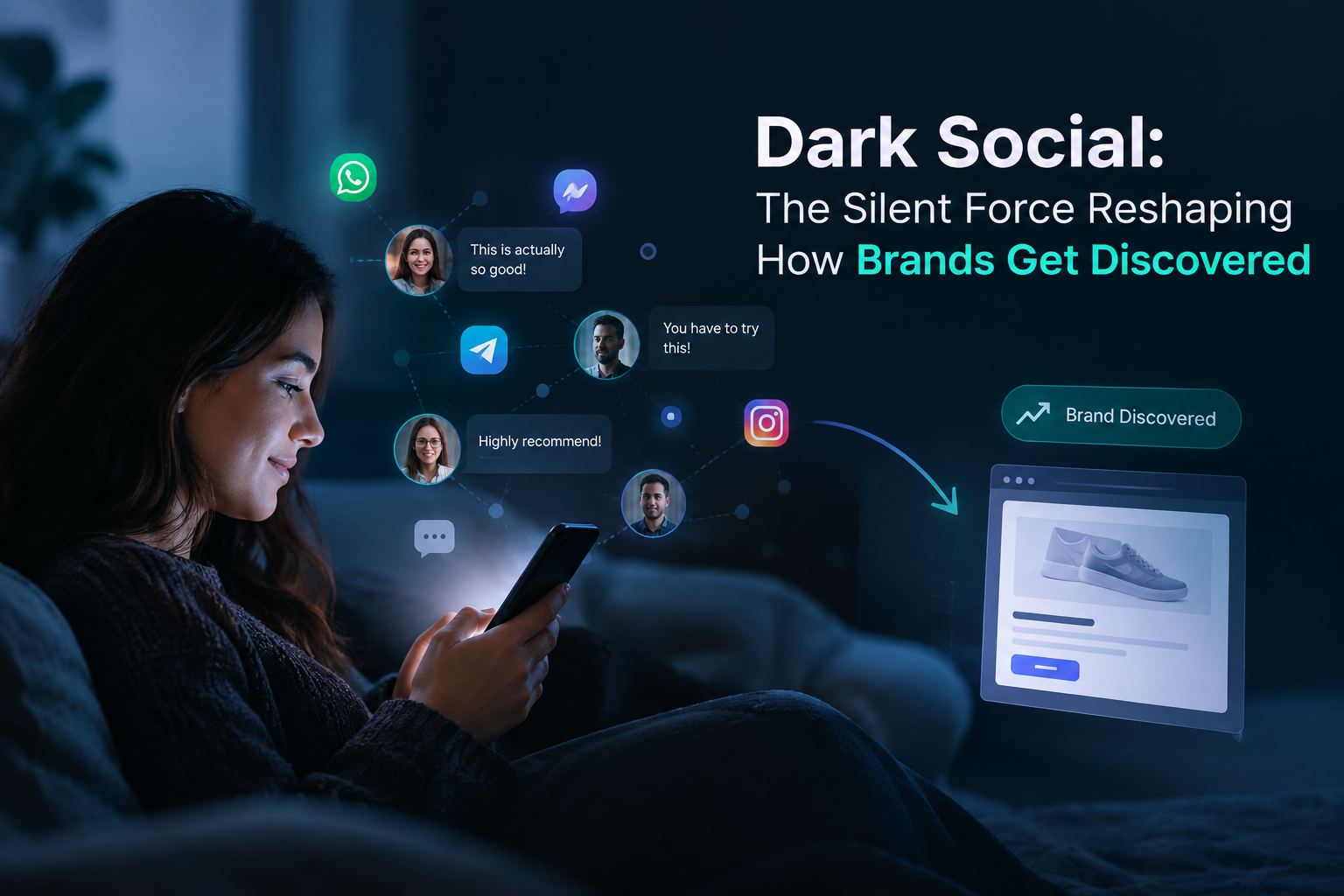
The dark social meaning is anything that is sent via a private platform, such as WhatsApp messages or texts, email or Slack, Instagram DMs, private Discord servers, etc., and isn’t visible on the standard web analytics. If a person uses a link he/she copies from the link and pastes the link into a private chat instead of clicking on “share” in the public platform, his click is counted as direct traffic in the analytics even though it was a real personal recommendation.
It is not at all dark; it is invisible—a blind spot in the data.
Dark Social vs. Dark Web: Don’t Confuse the Two
A point of clarification right off the bat: Dark social is not related to the dark web. The dark web is a section of the internet that is masked and encrypted, used by special software such as Tor, which is usually engaged in anonymous or illegal activities.
Dark social is the opposite of that—it is perfectly mainstream and normal. It’s just the sharing of products through WhatsApp by a friend or the sharing of an article by a colleague via email. It’s not hidden, and it’s not illegal; there are only a few things that are “dark” about it, and they are that it’s invisible to tracking tools.
Why Dark Social Matters So Much Today
Various research reports indicate that most social sharing is occurring via private (or dark) channels, typically 60% to 90% depending on industry and platform. This is a far cry from a decade ago, when platforms such as Facebook and Twitter were the places to share publicly.
- This shift is occurring for a number of reasons:
- Privacy fatigue—less willing to share opinions, purchases, and interests in public.
- The growth of messaging apps—WhatsApp, Telegram, and iMessage are now the apps used for billions of primary messages.
- Rely on personal networks (ex., recommendations from friends and family are more influential than posts from brands or strangers).
- “The algorithm fatigue”—platforms are becoming pay-to-play, and as a result, organic conversation is moving to private spaces.
Dark Social Media: Where the Conversations Actually Happen
Discussing dark social media is about the platforms and channels themselves and the invisible sharing happening on them. These are not “nooks and corners of the web”—they are among the most popular apps in the world.
- Some of the most important dark social channels are:
- These days, messaging applications like WhatsApp, Facebook Messenger, iMessage, Telegram, and Signal are being used a lot.
- Friends and relatives—personal recommendations, forwarded newsletters, links, etc.
- Private group chats: family groups, friend groups, work Slack groups
- For instance, Instagram direct messages, X/Twitter direct messages, and LinkedIn messages.
- There are a number of community platforms for private Discord servers, closed Facebook Groups, WhatsApp Groups, and more, all of which are free to use.
Dark Social Media Examples in Everyday Life
To help make this real-world, consider these examples of dark social media in action, which are occurring every day—and many times unnoticed by marketers:
- A friend sends a link to shoes and writes, “You’d love these.”
- People take screenshots of a tweet and share it through WhatsApp rather than retweeting it.
- One of the co-workers sends an article in an email with the subject line: “Thought of you when I read this.
- A user shares a product link in Instagram in a group chatroom and asks, “Has anyone tried this?
- The Reddit thread is screenshotted and posted in a private Discord server.
- Parent posts a link to a recipe in a family discussion group.
In all instances, if the recipient clicks, that is recorded as a “direct visit” (or a “direct sale,” in the case of sales) and no indication in the analytics that any high-trust human recommendation led to the click.
Dark Social in Digital Marketing: A Critical Blind Spot
That’s what makes dark social in digital marketing a hot topic, and brands are gaining customers this way without them knowing, measuring, and optimizing directly.
This isn’t a task that falls well to traditional attribution models. They are based on data from referrals that can be tracked, and dark social doesn’t have by definition. Marketers are responding by:
- When “direct traffic” starts to increase significantly—when there are sudden and inexplicable increases in traffic, it is likely that content is going viral in private channels.
- Utilize social listening tools, which are able to detect mentions in semi-public forums, such as forums or public Reddit threads.
- Cohort analysis of time on site and pages visited can show if “direct” traffic is “warm referrals” or “cold traffic.”
- Retesting for brand awareness and sentiment over time is a better indicator of influence than click tracking and is a good way to do the brand lift study.
Dark Social Marketing: How Brands Can Adapt
Dark social is not something that can be tracked directly, so it’s a mindset shift in dark social marketing: rather than trying to get the right attribution, you want to create content that is naturally shareable in dark social.
Strategies that work:
- Make content “forward-worthy.” Make content that resonates with and is useful or surprising enough to get a “you need to see this” response from one person.
- Add share-friendly features. Include “Share via WhatsApp” or “Copy Link” buttons, rather than generic social sharing buttons – this puts a slight steer in the direction of dark sharing.
- Tag your own links. UTM parameters in e-mails, ads, and influencers retain some source information despite private sharing.
- Get memorable branded URLs. Short and easily remembered links are more likely to be retyped or remembered, providing an indirect signal.
- Ask directly. Companies can find out that a friend sent them a link is more common than other official channels by just asking a simple question at checkout.
Dark Social Reddit: A Unique Hybrid Case
There is an interesting middle ground in this discussion for Reddit. While they are public, there is a tremendous amount of dark social Reddit activity through these:
- Photos of Reddit posts in private group chats
- The link is copied from Reddit and sent through a DM or text message.
- Reddit comments that are referred to in private Discord servers but have not been posted here. Reddit comments that are referred to on a private Discord server but not posted here.
Although Reddit is a public site, it’s also a great source of dark social sharing. One little recommendation in a small subforum can expand into thousands of private messages that don’t lead back to Reddit as the source. Brands can use relevant subreddits to enjoy a certain level of participation without the fanfare, and this participation can still lead to sharing that will take place outside the platform. Brands can participate in the relevant subreddits without hype, and this participation can stimulate the sharing that happens off-platform without people realizing it.
Building a Dark Social Strategy
A conscious dark social is not a matter of covering the blind spot; it’s creating one around it.
- Check for any direct traffic anomalies relating to content releases or campaigns.
- Make sharing frictionless—with copy-link and messaging-optimized share buttons.
- Make “send to a friend” experiences—quizzes, calculators, or personalized results- something a person wishes to send to someone.
- Use the same UTM parameters for all of your products.
- At checkout or upon signing up, directly ask customers how they came across your business.
- Think brand trust, not reach—dark social is based on recommendation, so provide something people can talk about.
Final Thoughts
Dark social is no fad: it’s just the way social interaction appears when people are more focused on privacy than on the public sphere, more on personal handheld devices than on desktop computers. Brands that stick to the public platform are at risk of missing out on a huge portion of discovery.
Knowing about the dark meaning, knowing what examples are dark social media, and knowing how to plan for dark social media will not make your data 100% perfect, but it will give you an advantage in a world where the most influential and visible media are not necessarily the most powerful.
It could be in a DM, group chat, or forwarded email that the next customer conversation is taking place. It’s not whether your brand needs to be talked about at those times and places, but rather whether it’s worth being talked about.